01
Scope gets split
Specifications, roof plans, details, and addenda can each change what belongs in the lightning protection price.
Lightning protection estimating
TradeSpec turns plan and spec sets into a source-backed first pass: scope notes, quantity assumptions, RFIs, exclusions, and review-ready outputs your estimator can verify before bid day.
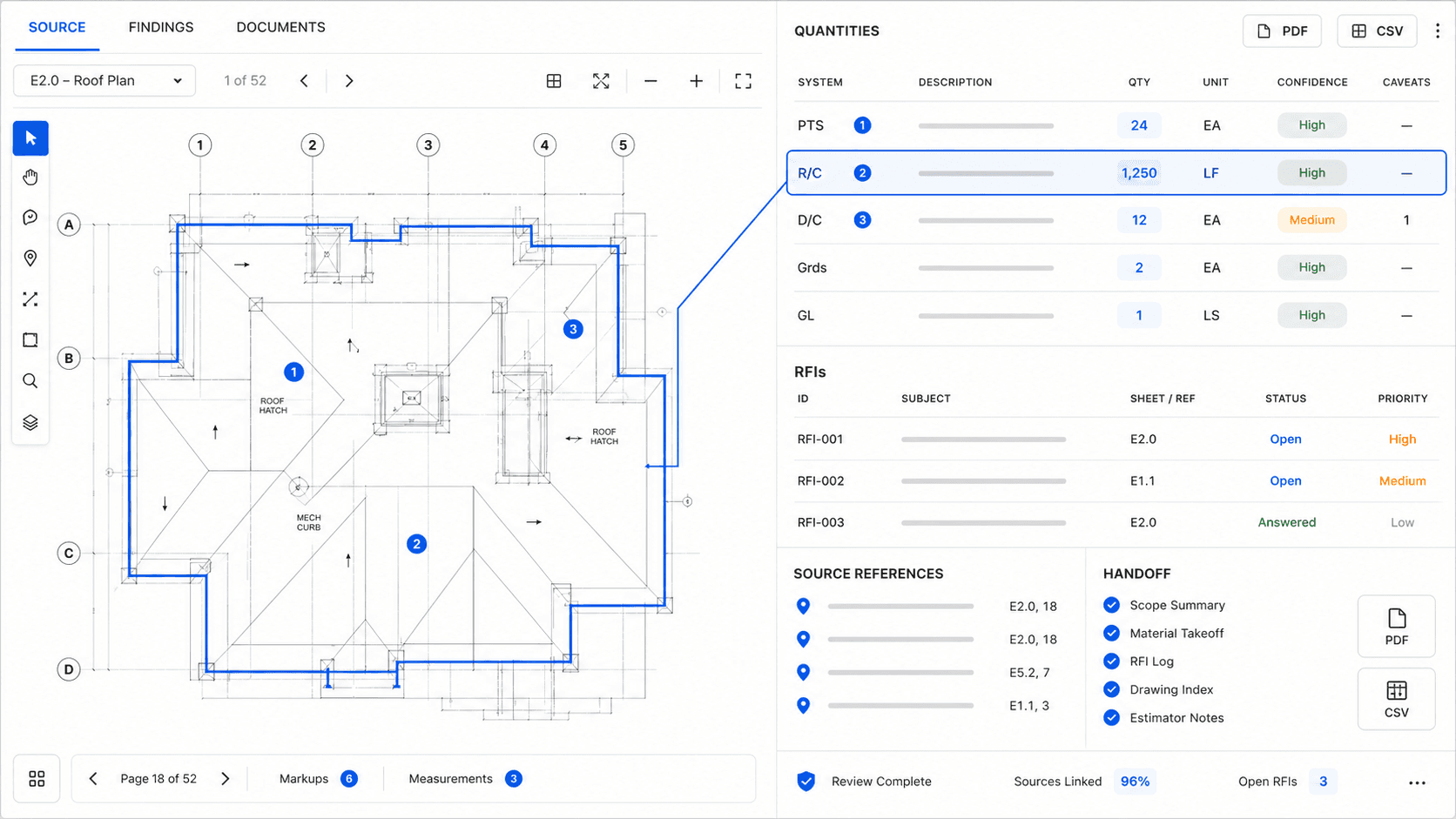
The estimating gap
TradeSpec helps estimators pull that scattered scope into one review path before final pricing.
01
Specifications, roof plans, details, and addenda can each change what belongs in the lightning protection price.
02
Routing, grounding, test wells, exclusions, and alternates often live in notes that are easy to miss during bid pressure.
03
A useful first pass has to show which sheet or spec created each finding so the estimator can verify it.
Source traceability
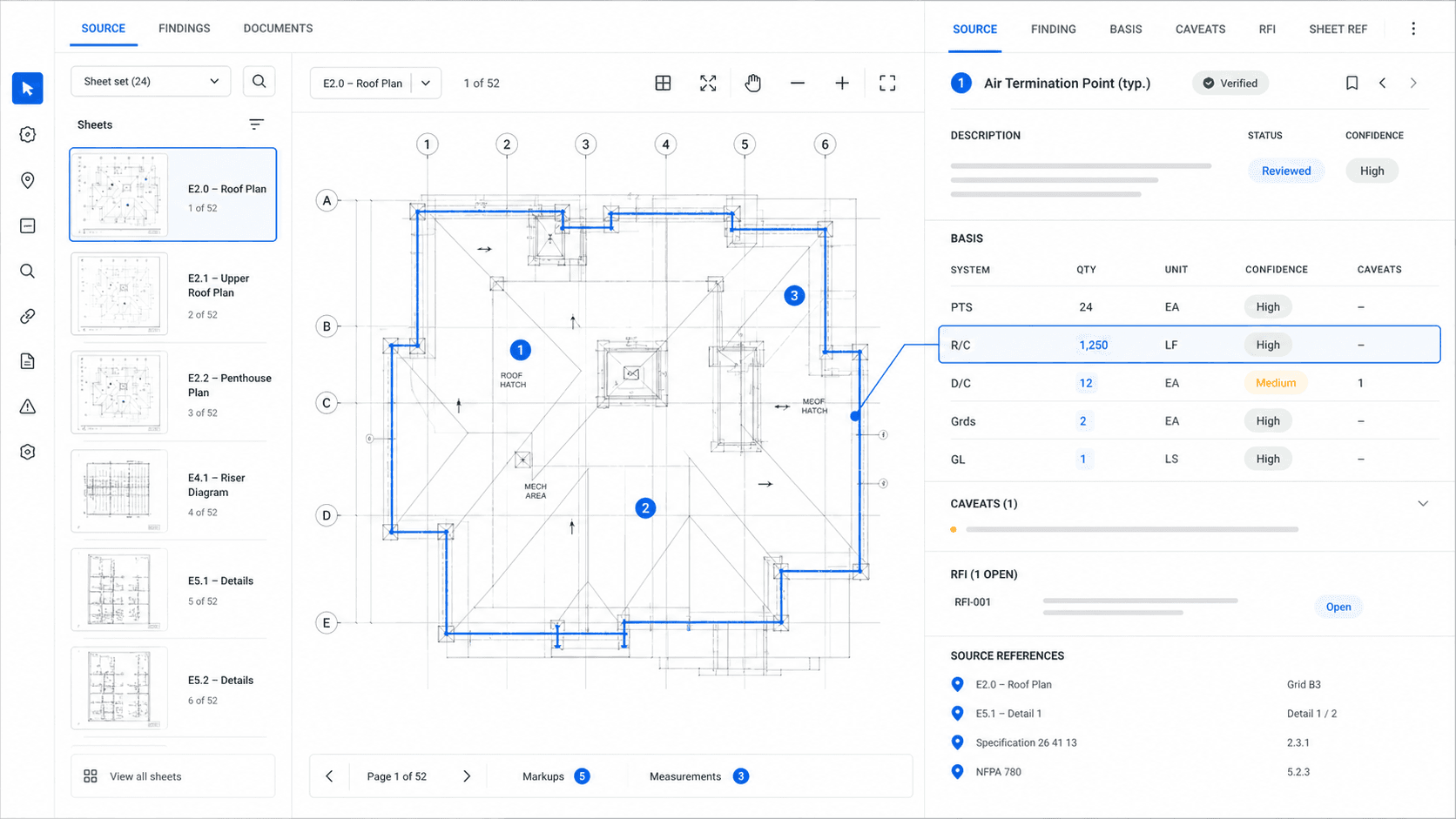
TradeSpec is useful only if your estimator can check the work. Scope notes, quantity assumptions, RFIs, and exclusions stay tied to source references.
01
E-402 roof plan and 26 41 00 specification
02
Lightning protection scope, routing, and grounding items identified
03
Carry, revise, exclude, or send an RFI before final pricing
How it works
The workflow is designed for pilot evaluation on real estimating work, not a generic demo file.
Step 1
Share the plan/spec set and the estimating context you want to compare against.
Step 2
The first pass organizes scope, quantity assumptions, RFIs, exclusions, and source references.
Step 3
Your estimator checks the source trail, adjusts assumptions, and decides what belongs in the bid.
Step 4
The final package gives the team a clearer starting point for pricing and follow-up.
What you get
TradeSpec separates the pieces an estimator needs to inspect: what was found, where it came from, what was counted, and what still needs a decision.
Lightning protection scope, included areas, and bid-form questions.
Bucketed items with units, source references, and assumptions.
Clarifications, exclusions, alternates, and unresolved routing or grounding questions.
The drawings, specs, and addenda behind the review.
Why teams trust it
TradeSpec prepares the first pass. Your estimator keeps final judgment. Unclear scope stays visible instead of being hidden inside an answer.
TradeSpec does not replace estimator judgment.
The copy does not claim guaranteed quantities or bid-speed improvement.
Assumptions, RFIs, exclusions, and source references remain part of the output.
Sample review pack
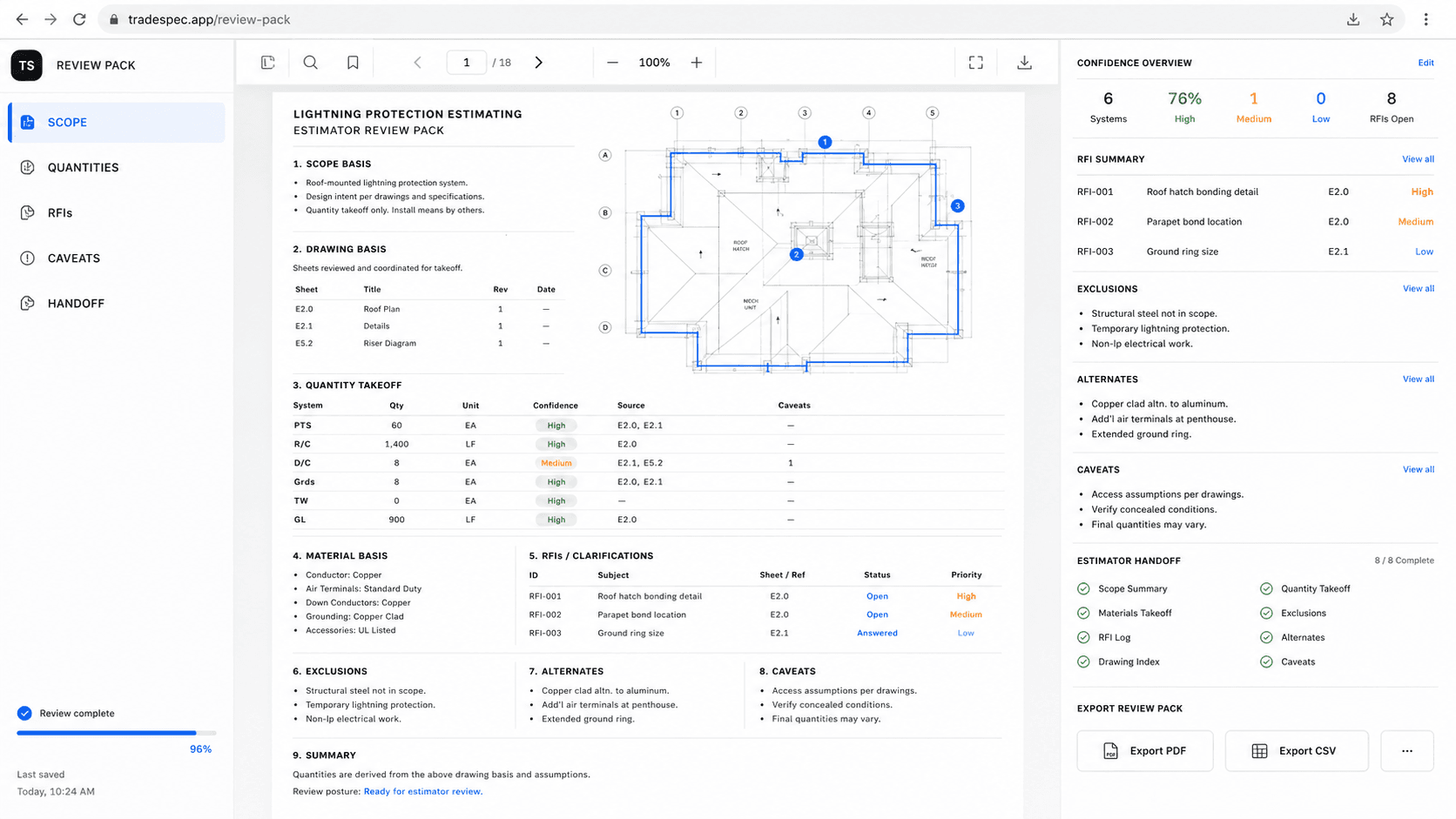
The sample shows how a lightning protection review can carry scope, quantities, RFIs, exclusions, and source references in one place.
Common questions
No. TradeSpec prepares a source-backed first pass so an estimator can review faster and make the final bid decisions.
A real lightning protection bid package with enough drawings, specs, and timing pressure to compare against your current review process.
A review pack with scope notes, quantity assumptions, source references, RFIs, exclusions, and estimator-ready next steps.
Not for the first pilot. The first package is coordinated directly so the review matches the way your team estimates.
Compare the sample or pilot output against your current takeoff and review process: clarity, source traceability, missing-scope risk, and usefulness for the estimator.
Pilot fit
Send one real plan/spec set, review the output with your estimator, and decide whether the first pass is worth adding to your bid workflow.